Japanese Knotweed
Japanese knotweed (Fallopia japonica) is a non-native invasive brought over from Asia as an ornamental plant. Knotweed spreads vegetatively by rhizomes and also sprouts from fragments of root and stem material, which are dispersed by water, equipment, or in fill. It forms fertile hybrids with giant knotweed (Polygonum sachalininese). Some populations, particularly hybrids, produce fertile seed. Knotweed forms dense monocultures, with a thick layer of accumulated leaf and fibrous stem litter. A number of mechanisms contribute to its ability to exclude native species: light limitation, alteration in nutrient cycling, and allelopathy—the ability to suppress growth of a potential plant competitor by releasing toxic or inhibiting chemicals. Knotweed can contribute both to stream bank erosion and to flooding, when its large, fibrous stems wash into the water during periods of peak flow. Its rhizomes and shoots can penetrate asphalt and cracks in concrete. It is most aggressive on sites with natural or human disturbance; stream and riverbanks, roadsides and construction sites.
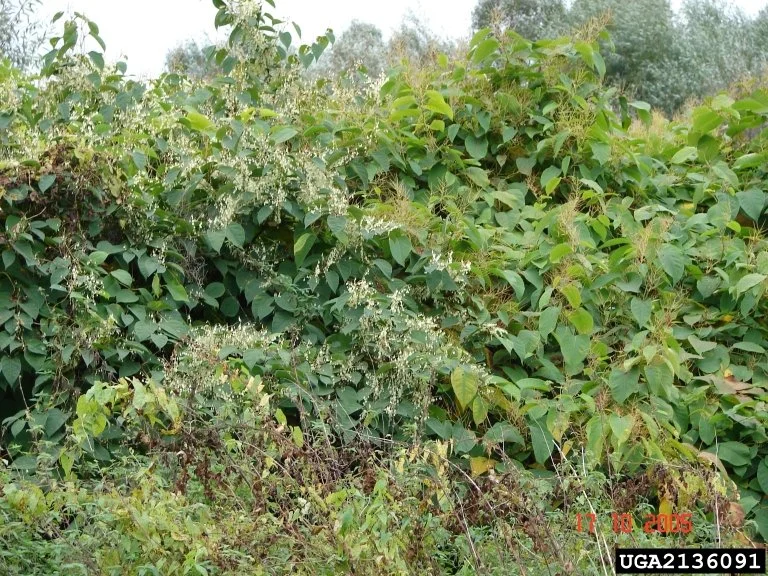
Japanese knotweed forms dense thickets that that shade out native undergrowth.
Photo: Barbara Tokarska-Guzik, University of Silesia, Bugwood.org
Identification:
•Up to 10 ft. in height.
•Large, oval leaves with pointed tip.
▫Up to 6 in. long and 5 in. wide.
•Round, hollow stems with papery leaf nodes.
•Small green flower clusters in late summer.
•Flowers on stalks at base of leaves.
•Three-winged fruit with dark, glossy seeds.
Habitat:
Found along roadsides, wetlands, wet depressions, woodland edges, and stream or river banks.
Full sun conditions are preferable, although this plant can tolerate some shade and a wide range of soil and moisture conditions.
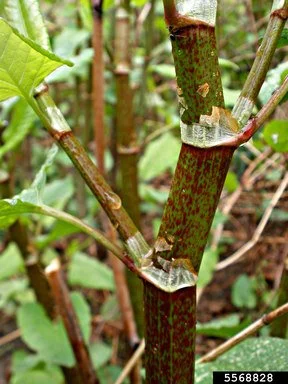
Papery membranes grow on the stalk at the leaf node.
Photo: Ansel Oomen, Bugwood.org
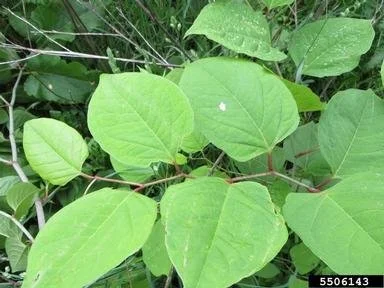
Japanese knotweed leaves are roughly half as long as giant knotweed.
Photo: Nisa Karimi, Wisconsin Department of Natural Resources, Bugwood.org
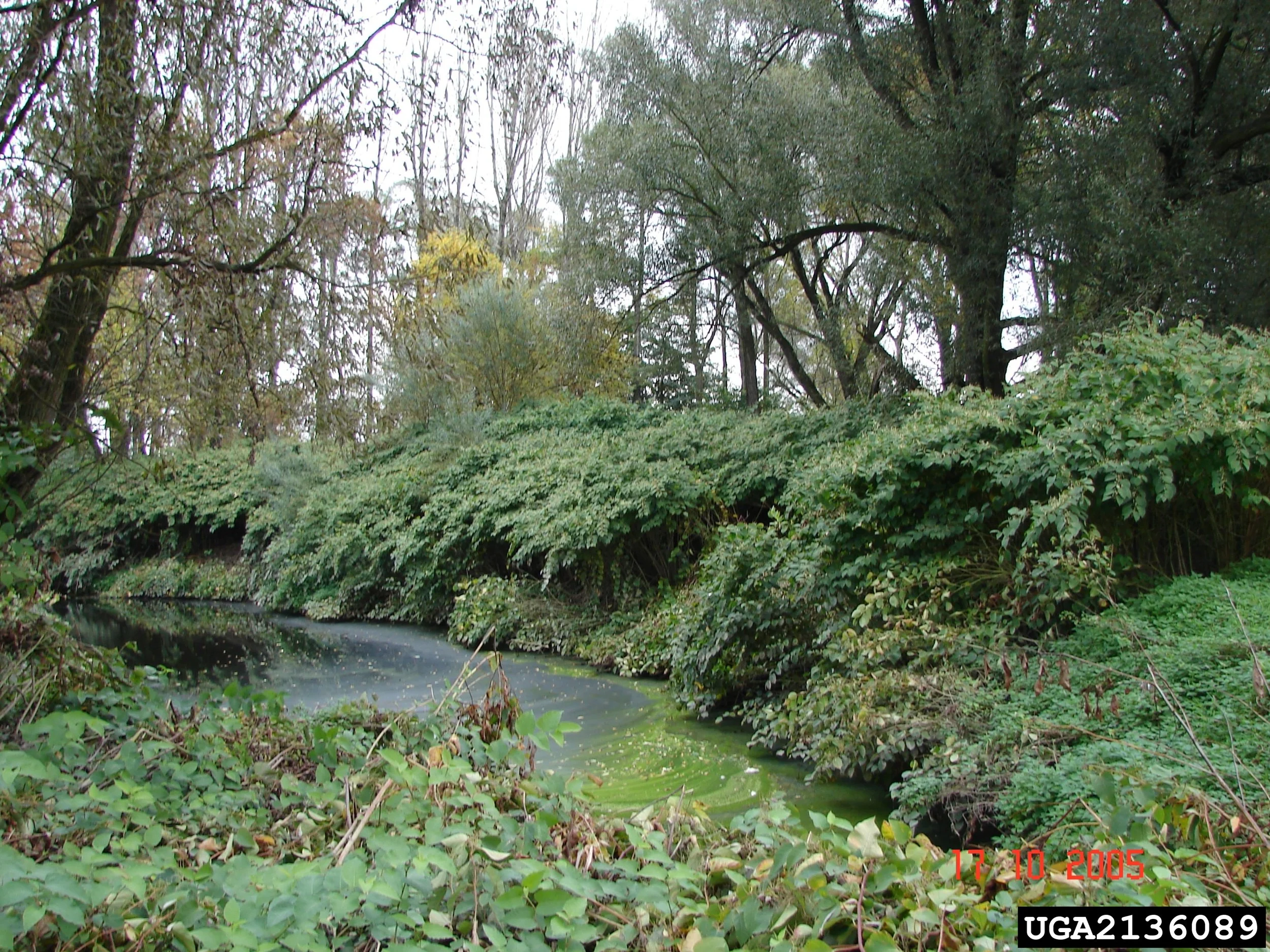
Japanese knotweed Reynoutria japonica Infestation
Photo: by Barbara Tokarska-Guzik