Giant Knotweed
Giant knotweed is an herbaceous shrub imported from Japan as an ornamental in the late 1800s. It was also planted for erosion control and livestock forage, but escaped cultivation and became a serious invasive species in several states. Giant knotweed forms tall, dense thickets that shade out and displace native vegetation and degrade habitat for fish and wildlife. Once established, it dominates native vegetation and is a significant problem in riparian areas where stream-side tree growth is greatly reduced. Thickets growing along streambanks can alter waterways and contribute to erosion and flooding. Research studies have also shown that giant knotweed produces allelopathic chemicals from its roots, which prevent other plant species from growing and competing with it. It spreads vegetatively through roots and broken stems, making it a particularly difficult plant to control.
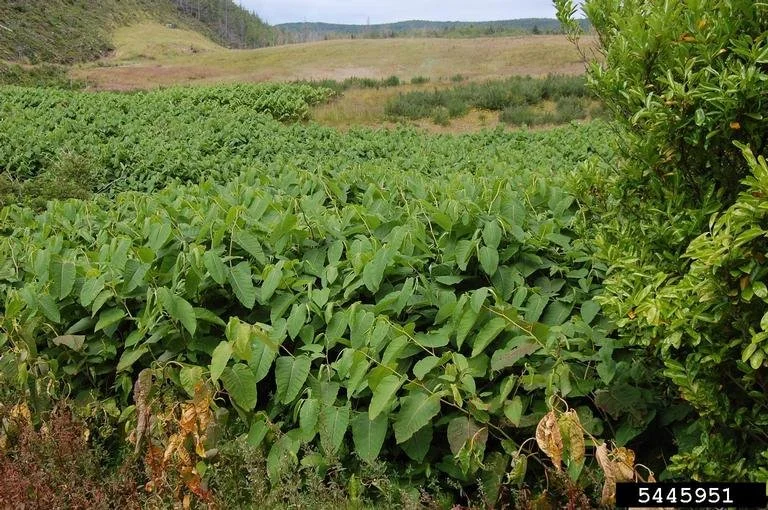
Identification:
Herbaceous shrub growing up to 12 ft. in height.
Large leaves (6-12 in.) with heart-shaped base.
White flowers grow on stalks at base of leaf.
Flowers bloom in August and September.
Hollow stalks are light green and swollen at the nodes, resembling bamboo.
Three-winged fruit with glossy dark seeds grow on stalks at leaf base.
Giant knotweed can tolerate a wide variety of soils and moisture conditions, establishing easily in new locations.
Photo: Robert Emanuel, Clean Water Services, Bugwood.org
Habitat:
Giant knotweed is often found in sunny areas within intentionally planted landscapes, along roadsides, and in riparian areas such as stream banks. Knotweeds thrive in a range of soil types and light levels although will not be as robust if growing in shady conditions.
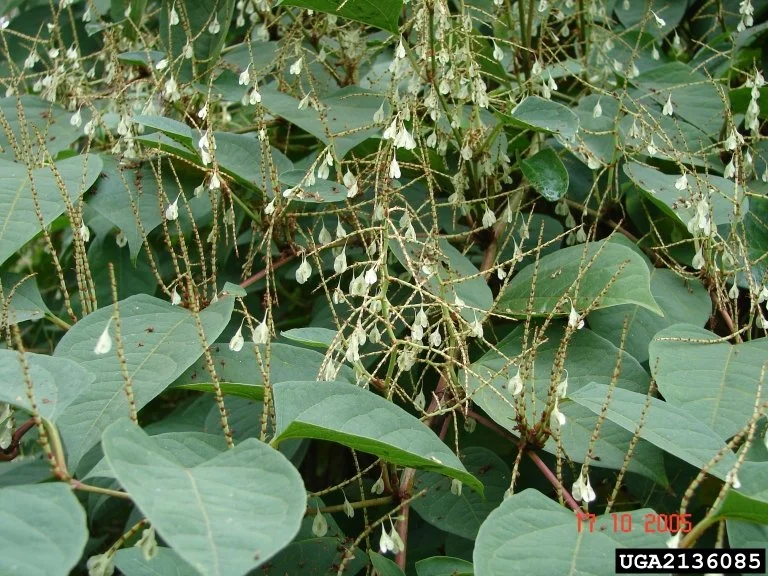
Winged fruit grow on stalks at the leaf base. Photo: Barbara Tokarska, University of Silesia, Bugwood.org
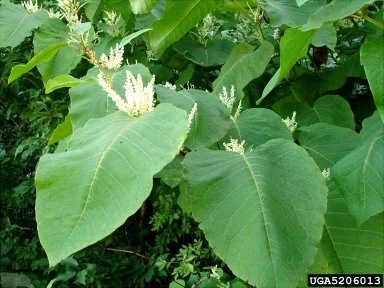
Small white flowers grow sprout from the leaf axils and stem tips.
Photo: Jan Samanek, Phytosanitary Administration, Bugwood.org
Additional Resources:
Michigan Invasive Species Website
MISIN Species Training Module